after the opera house
itself between, of saying farewell

In 2013, my great-uncle (GUB, as he was known), an aficionado of all things high culture, took me to see Alban Berg’s Wozzeck. I fell asleep on the front row, snoring, and I was not invited back.
However, by the time he died a few years later, I had developed a deep fascination with the Second Viennese School, Berg, Webern, Schoenberg, etc., and with all things atonal and experimental classical. Insufferable at parties? Highly likely. I would still credit the first thirty or forty minutes of Wozzeck as the jumping-off point. Cut to a decade later, and Discreet Archive have just released itself between, of saying farewell, a (post-?)opera by Bridget Ferrill and Áslaug Magnúsdóttir that moves through a strange and intimate parable of attachment, pain and release. It is funny what small moments and kindnesses end up shaping your passions and future path, isn’t it?
I would say I still have some sympathy with Nicholas Till’s take on opera: “I don’t mind if something’s operatic, just as long as it’s not opera,” and perhaps I still would not stay awake through all of Wozzeck. But I am thrilled to say that Bridget and Áslaug’s deconstruction of the form builds something that is truly post-operatic. Earlier this year, I listened obsessively to Sean McCann’s The Leopard, a work that sits somewhere between radio play, opera, sound work and imaginary film (surely another contender for the post-opera activity badge). It led me to think about what remains of an opera once you remove the opera house, the scenery, the spectacle and even the expectation that anybody should sing operatically, or at all.
To me post-opera is not simply mean an opera made recently, or one with electronics or unusual instrumentation. I would understand it to be a work made from opera’s component parts: transformation, ritual, repetition, character, voice and emotional excess, but without rigidly adhering to established structure and form. The emotional voice of the work does not have to belong to a body; it can belong to an electrified harp. The music does not have to accompany the drama because it can simply become the drama. An opera can be an album, installation, broadcast, book or some unstable mixture. I think it is this repositioning of these materials that earns the label, and hopefully satisfies Nicholas Till’s tastes.
This was in my mind when Bridget sent over the album. Before even listening, I could see the track names exploiting the language of the form: Prelude, Aria, Mad Scene, Leitmotif, Fioritura, Finale Concertato and Zwischenspiel. Here was the form hollowed out and rebuilt as something as dramatic as anything at the Royal Opera House.
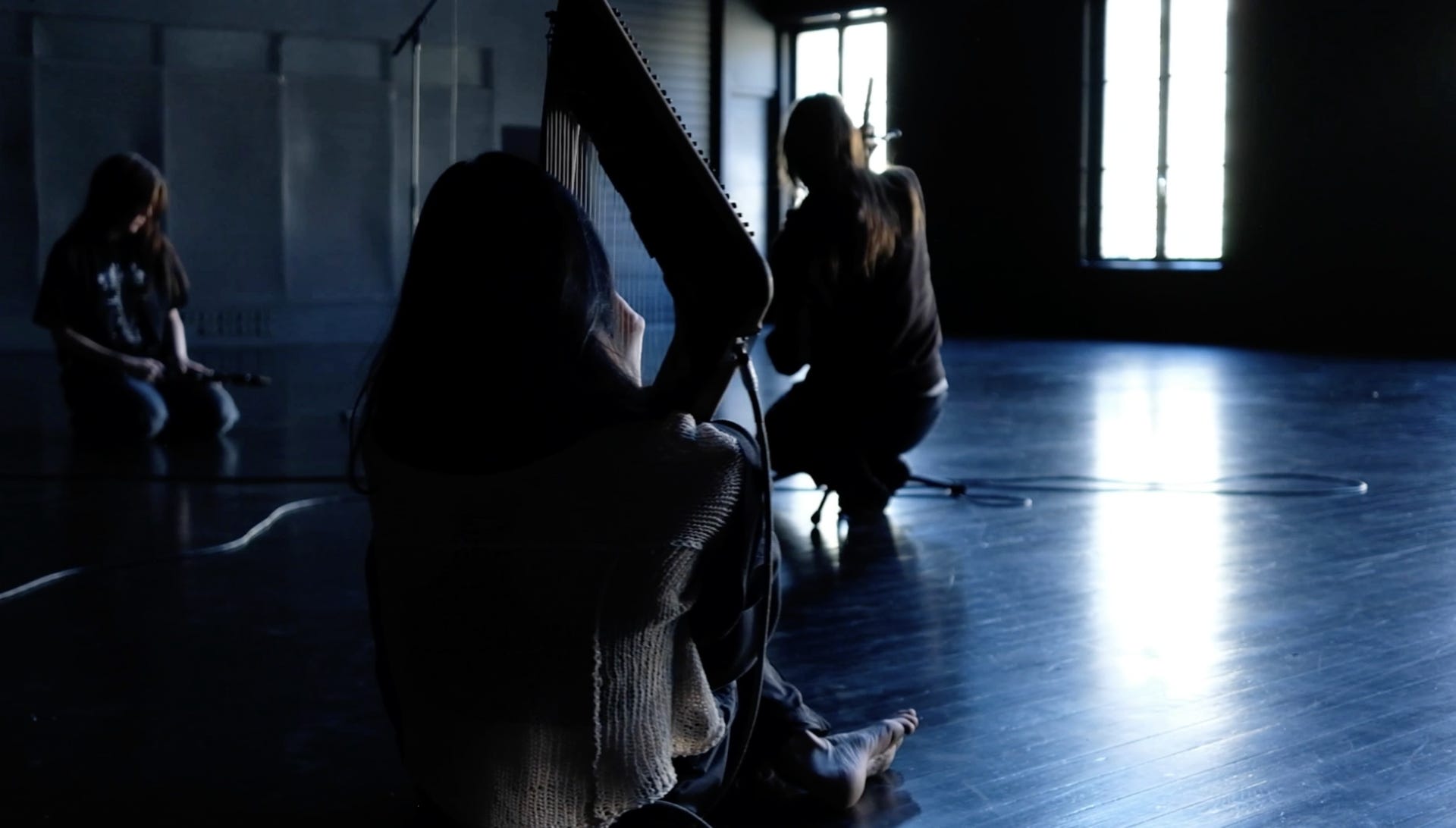
Instead of kings, gods or doomed heroines, there are Shoe, Foot and Nail. Shoe loves Foot. Foot is leaving to find the House of Bliss. Shoe persuades Nail to fasten them together, and Foot continues walking despite the pain. Around them move three choruses: Blood, Dust and Swan. It is a simple structure, almost a children’s story, but it contains multitudes. Shoe can be shelter, devotion, possession and obstruction. Foot is a body, but also movement, hope, the possibility of leaving and the possibility of change. Nail binds them together, creating the wound that makes their bond unbearable. The work can be seen as a relationship, habit, tradition, house, or a way fear settles into the body and determines the route.
The libretto moves between deeply emotional parable and ordinary life. Alongside the wounds and obsession are bags being sewn, chandelier crystals cleaned, curtains left open, cakes redesigned and a chicken being knitted as a gift. I love that it does not make emotional pain grand in the predictable operatic way. The emotional scale is enormous, but the material remains domestic and somewhat awkward. The tragedy is not that a kingdom has fallen, or a god has been brought mortally low. It is that somebody cannot leave the house, cannot stop offering all of themselves, and has mistaken holding everything together for love.
The sound world similarly deconstructs tools with old and grand associations. Harp, clarinet and clavichord are recorded closely enough that their mechanisms become exposed. They are often played with a deftly naïve attitude that undermines their classical associations. On top of this base milieu of more expected instrumentation is a contemporary electronic sound world, with visible electronic manipulation, while Olivia Rivière’s voice and microphone practice provides challenging interjections at extreme emotional volume.
This album is certainly where post-opera, radio play and sound art meet. There is no visible stage other than the one imagined by the listener. We are able to decide where the voices are, what bodies they have, and whether a sound belongs to a room, instrument, memory or wound.
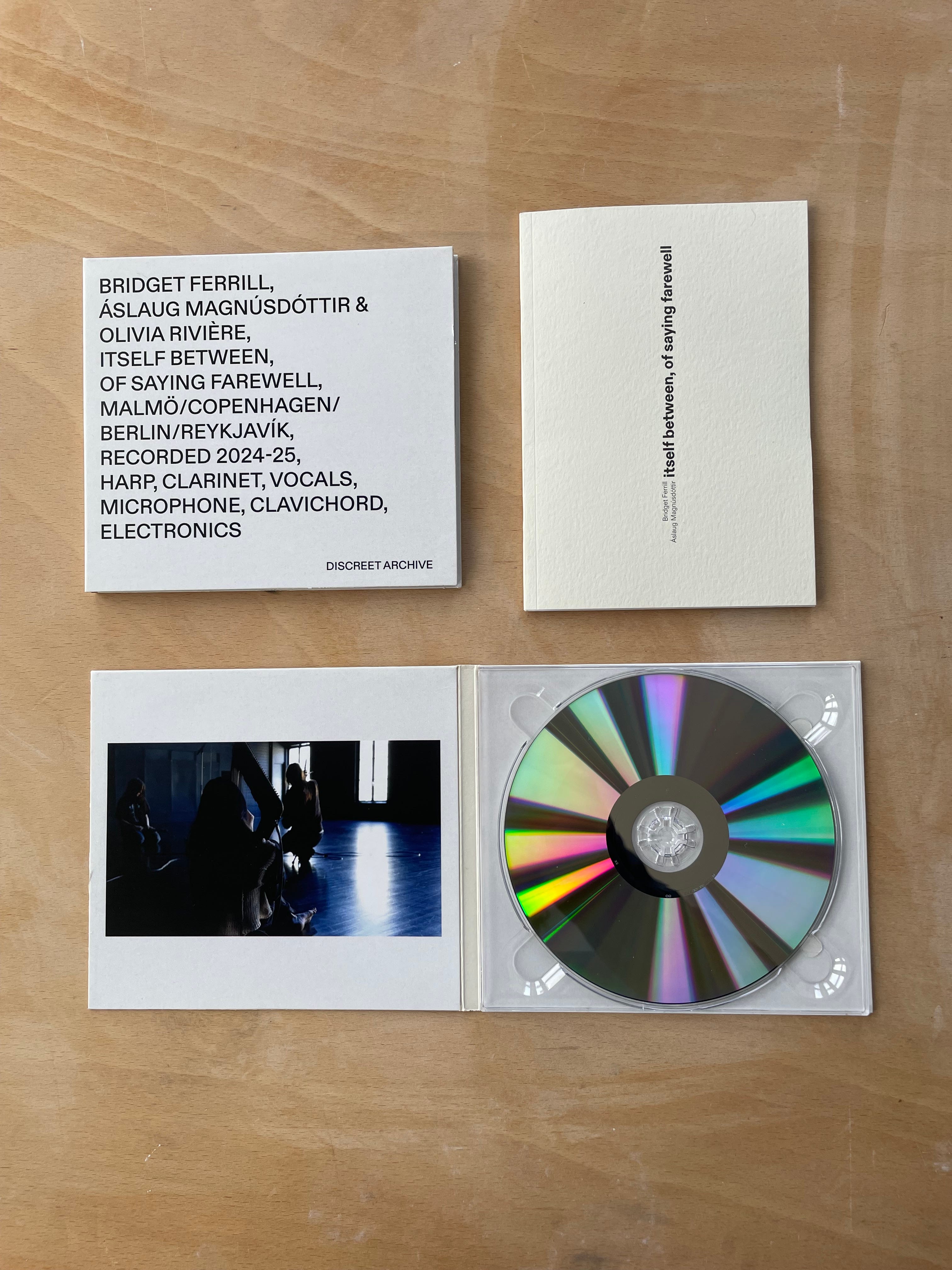
Opera is usually imagined as an expensive public form, tied to institutions and specialist (wealthy...) audiences. But I think a more interesting future might also be more intimate, distributable, independently made and wildly exploded in form. It can travel as a CD and small book, or simply digitally. Recorded in Malmö, Copenhagen, Berlin and Reykjavík, it arrived in a house in West Wales and was then sent on to Tokyo or Los Angeles.
The album uses centuries of formal memory while sacking off the institution that produced it. itself between, of saying farewell does not necessarily reject opera. It handles opera as useful material: some beautiful, some ridiculous, some still carrying great charge. It asks what an aria, mad scene or finale might become when grandeur gives way to closeness and intimacy.
Anyway, thanks for listening,
Jacob / Discreet Archive
itself between, of saying farewell is available now as a CD with a 28-page libretto via Discreet Archive.
Hola , Este Álbum Es Una Obra De Arte En Sí. Desprende Magia Por Todos Lados. Un Saludo.