Revisiting Subtle Vessel
A room, a tank, a body of water

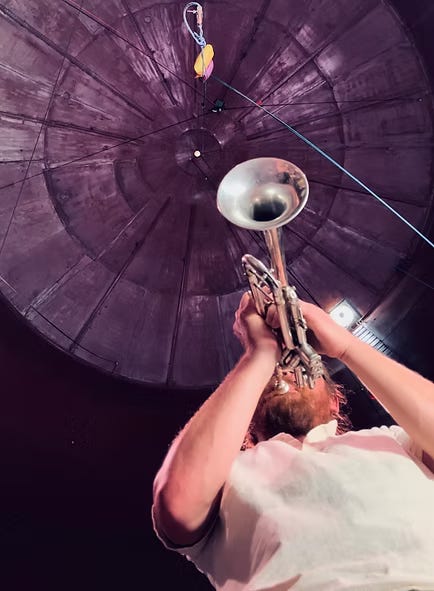
A few months after releasing Matthew Langford’s Subtle Vessel, I find myself returning to it less as a finished album and more as a situation that continues to unfold. It is, of course, an album: a long-form work of trumpet, flügelhorn, delay, voice, space, and resonance. However the album really just feels like the trace of a set of conditions. A date repeated across three years. A recording made, re-recorded, and folded back into itself. A seven-story resonant chamber. A 400-gallon tank of water. A body standing inside that water. Breath moving through brass. Sound returning altered by the material.
The history of the piece begins with a voice memo made at a piano in Lakewood, Colorado on July 26th, 2022. One year later, on July 26th, 2023, Langford returned to that recording and made live re-recordings of it, adding trumpet, flügelhorn, and simple delay effects. Then, on July 26th, 2024, he brought those accumulated recordings into the Tank. Before playing, he soaked for thirty minutes in a 400-gallon body of water while the material from the previous two years was played into the space and recorded again. Standing in the water, he then made five further re-recordings, continuing to add layers of trumpet and flügelhorn until the album reached its final shimmering form.
The connection to Alvin Lucier’s I Am Sitting in a Room is clear, and Langford acknowledges this and leaves it visible. For those unfamiliar (although if you’re here I might guess you do know it...) Lucier’s piece begins with a spoken text recorded in a room. That recording is played back into the same room and recorded again. The process is repeated until the particular resonant frequencies of the room gradually overtake the voice. The room becomes increasingly present as the speech blurs. It remains one of those rare experimental works whose premise can be explained very quickly, while its implications keep expanding and evolving the longer you sit with it. Lucier’s piece is often discussed as a work about resonance, process, voice, and space, all of which is true. What still feels so strong to me is the way it makes the conditions of listening impossible to ignore. The room is no longer simply neutral container. The recording device is no longer an invisible means of capture. The voice is no longer treated as a stable human centre. Everything in the chain acts on everything else. A spoken sentence becomes a way of measuring an acoustic environment . So why return to this process now? More than fifty years later, why is it still interesting to revisit I Am Sitting in a Room?
I think part of the answer is that Lucier’s question has aged well because the world has moved further in the direction his piece works to resists. In a digitally native world, we increasingly encounter sound as something detached from material conditions. Voices are cleaned, compressed, corrected, transmitted, generated, stripped of room tone, stripped of breath, stripped of the accidental marks of place. Audio arrives through systems designed to make themselves transparent. Noise is treated as a problem (all the while creating too much of it but that’s for another post...). Space is treated as something to be managed and The sonic fingerprints of transmission are smoothed away.
Against that, Lucier’s process still has force because it insists that sound is changed by the world it passes through, It makes contact, it is messy. Langford takes up this inheritance in subtle vessel, though the album feels like a cousin to Lucier’s work rather than a straightforward variation. While resemblance is there in the use of repeated playback and re-recording, the differences are just as important. Langford changes the scale, the timespan, the material setting, and the role of the performing body.
The first major shift is the Tank itself. The Tank Center for Sonic Arts is a former railroad water treatment tank in Rangely, Colorado. It is a huge resonant space, seven stories high, with an acoustic life that has become almost legendary among musicians who work with duration, tone, and resonance. Sounds made inside it do not disappear after they are produced. They bloom, smear then return. A brass tone can feel as though it has grown larger than the breath that produced it. Small gesture become architectural. This matters because subtle vessel begins with something small: a voice memo at a piano. A private recording, casual. Across two years it is carried into a space that vastly exceeds it. I like that movement which feels central to the album. Nothing is simply enlarged, the material is placed under pressure and exposed to a different set of conditions, allowed to change.
(Also see our release last year from Mattie Barbier which also utilises this space).
The second shift is time. Lucier’s repetitions unfold as a process we can hear within the piece. Langford stretches the idea of return across three years. July 26th becomes a recurring point of contact across 2022, 2023, 2024. The same date holds the work together, giving it a structure something that feel closer to ritual, anniversary, or measurement than to formal development.
What changes when you return to the same material one year later? What remains in the recording? What has disappeared from the person making it? What does a space do to a sound that has already lived through other spaces? These are not questions the album answers directly, however they sit inside the process. The earlier recordings are present, but they are not treated as a fixed documents. They are played back into new conditions and changed again. Memory works like that, it is not recovered, It is re-exposed, re-lived. Each return thickens the material a little further. The original voice memo remains somewhere inside the album, but it is no longer a clear point of origin. It has been carried, sounded, altered, and partially obscured.
Thirdly, the water changes the work again. On the morning of the final recording, Langford brings a 400-gallon body of water into the Tank, and soaks in it for thirty minutes while the recordings from the previous years were played into the space. He then stood in the water and made the final re-recordings, adding the trumpet and flügelhorn. This detail could easily become the kind of thing that dominates a description of the album as it is so visually striking. It has a certain mythic quality, but what interests me is less the image itself than the change it makes to the system of the piece. The body is placed inside another body. The performer is held by water while playing into the Tank. Breath passes through metal, into air, into architecture, while the body is partially submerged in a substance with its own weight, pressure, and acoustic behaviour, the water is not decorative, simply for show. It changes the relation between performer and space and makes embodiment unavoidable. This is where the title subtle vessel begins to feel especially apt. The vessel could be the Tank, It could be the body, It could be the container of water, It could be the recording or It could be the album itself. Each holds something and each in turn changes what it holds. The brass also matters in this regard. Trumpet and flügelhorn bring the breath into the work in a very physical way. These are instruments of pressure, resistance, vibration, and fatigue. In the Tank, they become ways of activating space. Tones are sent out and returned as environment. The player hears the sound come back already altered, already partly belonging to the room.
There is a humility in that exchange that I find moving. The piece does not behave as though composition means total control over material. It sets up the conditions under which material can act. Langford plays, but the space also plays. The water, the playback system, the earlier recordings, the resonant frequencies of the Tank, the accumulated delay, the limits of breath, all of these become part of the work’s behaviour.
That is one reason the album sits so naturally within the Discreet Archive catalogue. I try not to think about the label as having a single sound, but I am interested in works that take place seriously. Works where the conditions of making are not incidental. subtle vessel is deeply aligned with that. It listens to space as an active participant. It treats sound as something shaped by contact, surface, memory, and environment.
Still, what keeps me returning to the album is its patience. The premise has a conceptual clarity, but the listening experience is not didactic. It does not explain itself as it goes. It asks you to stay with gradual changes in density, colour, distance, and decay. The drama is material rather than narrative. Tones gather, blur, recede. Earlier layers surface without announcing themselves. The work is dense, without becoming heavy-handed. I find this especially important when thinking about Lucier today, the continued value of I Am Sitting in a Room is not just historical, it offers a way of hearing that feels newly necessary in a culture obsessed with clarity, speed, and frictionless communication. Lucier allowed the voice to become less intelligible so that another form of specificity could appear. The room became audible through the loss of linguistic clarity. Langford carries that lesson elsewhere. In subtle vessel, the point is not to recreate the Lucier process faithfully. The album asks what repeated recording can do when the room is a Tank, when the process unfolds over years, when the performer is standing in water, when breath and brass keep entering the system, when memory is cross contaminated rather than preserved. It becomes a work about relation, between a small voice memo and a vast acoustic chamber. Between a body and a body of water. Between an earlier self and a later self. Between a canonical piece of experimental music and a contemporary practice with its own concerns, materials, and voice.
The more I listen, the less I hear subtle vessel as a response to Lucier alone. But to revisit Lucier today can still be interesting when the return produces new conditions rather than a closed reference. Langford does that beautifully here. It lets the work grow outwards from an inherited idea until it has its own pressure, its own atmosphere, its own internal weather.
It does not sit in a room. It stands in water, listens across years, and lets the tank answer.